

Contract Basics
How to Sign a Contract the Right Way (2026)
By FixMyContractLast updated Sep 19, 20266 min read
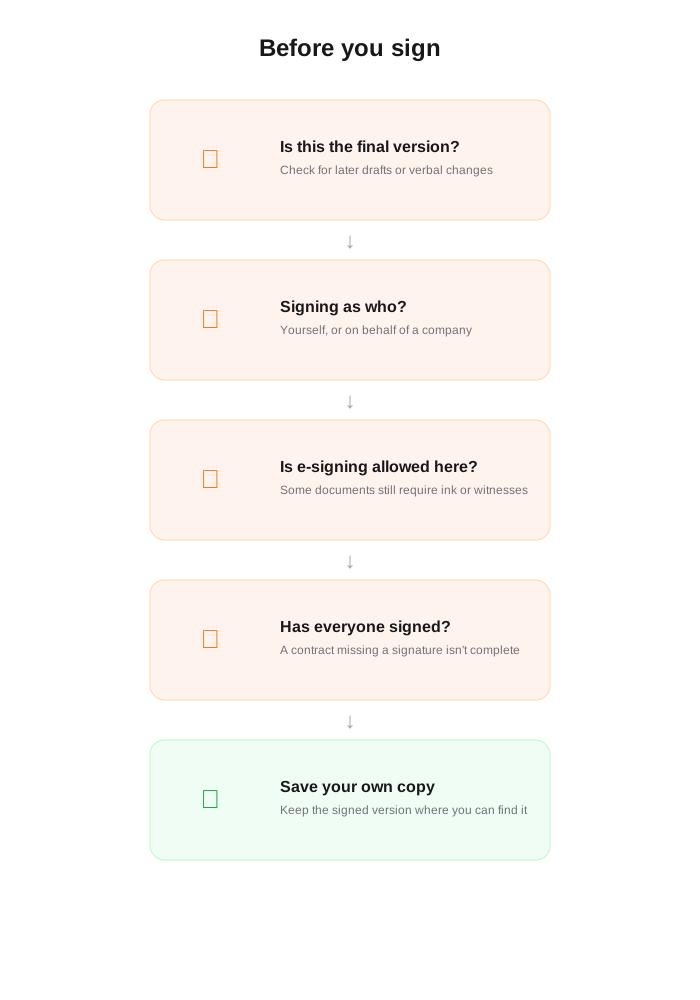
Signing a contract the right way means three things: you've actually read the final version (not an earlier draft), you're signing in the capacity you think you are (yourself vs. your company), and you keep a copy the moment ink — or a click — hits the page. Get any of those wrong and you can end up bound to terms you never saw, personally liable for a business deal, or unable to prove what you agreed to.
1. Make sure you're signing the final version
Contracts get redlined back and forth over email, and it's easy to lose track of which attachment is the one that actually reflects the last conversation. Before you sign: confirm the date/version in the document matches the most recent one discussed, and that any promised changes ("we'll cap the fee at $500") actually made it into the text — not just into an email thread. If it's not in the document, it's not part of the contract.
2. Know whether you're signing as yourself or as your business
This decides who's on the hook if something goes wrong. Signing "Jane Smith" personally is different from signing "Jane Smith, on behalf of Acme LLC" — the second generally protects your personal assets if the business can't pay, the first generally doesn't. If you have an LLC or corporation and you're signing on its behalf, make sure the signature block actually says so.
3. Understand what an e-signature legally does
Typing your name, drawing a signature on a screen, or clicking "I agree" through a service like DocuSign generally carries the same legal weight as a wet-ink signature for most everyday contracts. In the US, the ESIGN Act and state UETA laws establish this; in the EU, eIDAS does the same for at least "qualified" electronic signatures.
The exceptions are narrow but real, and they are where people get caught:
- Documents that commonly fall outside e-signature rules: wills and testamentary documents, some family-law papers (adoption, divorce), eviction and foreclosure notices, notices of termination of essential utility services, and court orders and filings.
- In the EU, eIDAS recognises three tiers — simple, advanced and qualified. Only the qualified electronic signature is automatically equivalent to a handwritten one; simple and advanced signatures are valid and admissible as evidence, but some member states still require a wet-ink signature or a notarial form for particular transactions (real estate is the usual example).
If your document is in one of those categories, check the requirement before you rely on a click.
4. Check who else needs to sign — and when it's actually final
A contract usually isn't binding until every required party has signed — if you sign first and send it back, you may just be making an offer that the other side can still accept, reject, or change. Look for a clause that says when the contract takes effect ("upon execution by both parties," or a specific effective date) so you know exactly when you're committed.
5. Keep your copy — the moment you sign
Save a signed copy (PDF, email confirmation, or the signing platform's completion certificate) the same day. This is your only proof of exactly what you agreed to if a dispute comes up later — and drafts get overwritten or lost far more often than people expect.
FAQ
Can I cross out a clause and sign anyway? Sometimes — but only if the other party accepts the change. Crossing out a clause and signing without the other side initialing the change can leave it unclear whether that clause was actually removed. Get any handwritten change initialed by both sides, or better, get a clean reissued document.
Does someone need to witness my signature? For most everyday contracts (leases, freelance agreements, service contracts), no. Certain document types — wills, some property transfers, some notarized agreements — do, and the list varies by location.
What if I already signed and now see a problem? Being unhappy with the terms after signing is usually not enough on its own, but there are real exceptions. See How to Cancel a Contract for what those are and how to raise one.
Not legal advice — a general guide to the signing process. Specific rules on witnesses, notarization and e-signature validity vary by location and document type.