

Contract Basics
What Is a Contract? The Basics Everyone Should Know (2026)
By FixMyContractLast updated Sep 19, 20266 min read
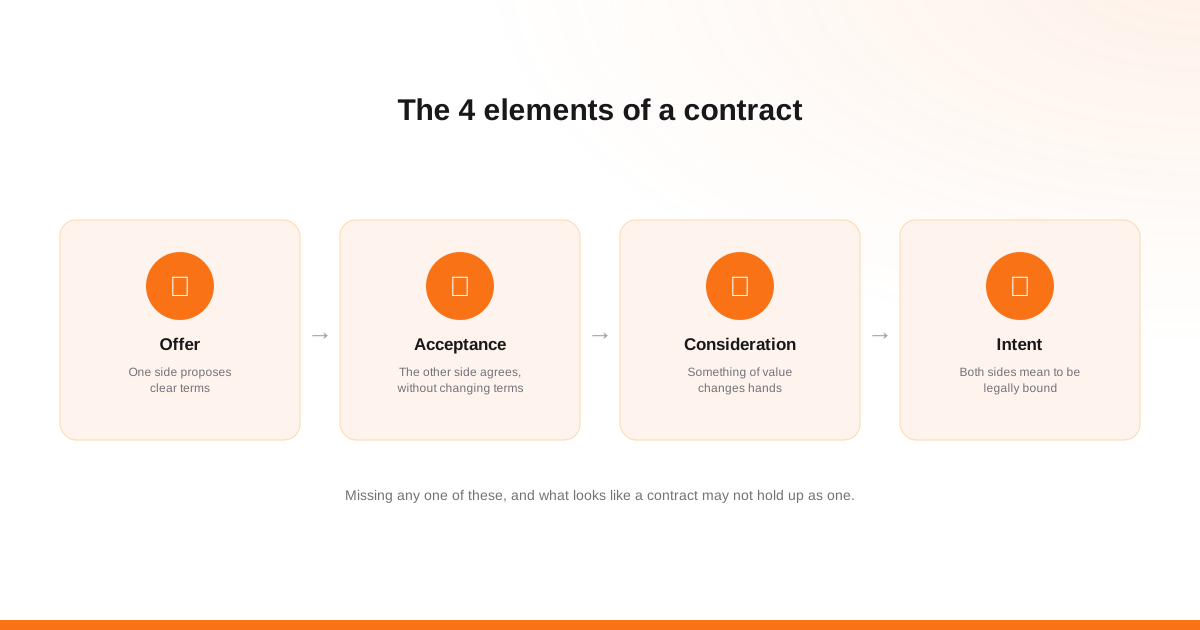
A contract is a legally enforceable agreement between two or more parties. For it to actually be enforceable — not just a promise someone can walk away from — it generally needs four things: an offer, an acceptance of that offer, consideration (something of value exchanged on both sides), and mutual intent to be legally bound. Miss one of those and what you're holding may be a courtesy, not a contract.
This four-element framework comes from common-law systems (the US, UK, Canada, Australia). Civil-law countries define a valid contract differently — usually requiring a lawful cause rather than "consideration" — though the basic idea of an accepted, binding offer is similar almost everywhere.
1. What makes an agreement a contract?
Not every agreement is a contract, and not every contract needs to be on paper. Courts generally look for the same four building blocks regardless of what the document is called:
- Offer — one side proposes specific terms ("I'll build your website for $2,000").
- Acceptance — the other side agrees to those exact terms, without changing them.
- Consideration — something of value changes hands on both sides — money, work, a promise to do (or not do) something.
- Intent to be bound — both sides understood they were making a commitment, not just chatting about a possibility.
2. Do you need a signature for it to count?
Often, no. Many everyday agreements — a verbal deal, an exchanged email confirming terms, a handshake over a price — can be legally binding without a signature or even a written document.
What usually does need to be in writing varies by contract type and location. In the US, a group of rules known as the Statute of Frauds requires certain categories to be written to be enforceable — typically real-estate transfers, agreements that cannot be performed within one year, and promises to pay someone else's debt. A quick freelance gig usually falls outside all of that.
3. What's the difference between a contract and a "letter of intent" or "MOU"?
A Letter of Intent (LOI) or Memorandum of Understanding (MOU) usually signals that two sides are serious about a deal but haven't finished negotiating — and most are written to be non-binding on purpose. The giveaway is usually in the document itself: look for language like "non-binding," "subject to a definitive agreement," or "for discussion purposes only." If you don't see that kind of language and the four elements above are present, treat it as a real contract.
4. Why does it matter what kind of contract you're signing?
The four elements are the floor, not the whole picture. A lease, a freelance agreement, a job offer, and a vendor contract all share that floor — but each has its own common risk points (deposit rules in a lease, scope creep in a freelance contract, non-compete clauses in a job offer). Once you know you're looking at a real contract, the next step is knowing what to check in that specific kind — see What to Check Before You Sign Any Contract.
FAQ
Is a text message agreement a contract? It can be, if it has an offer, an acceptance, and something of value exchanged — courts have enforced agreements made over text and email. The format doesn't decide whether it's binding; the content does.
Can I get out of a contract if I didn't read it before signing? Generally, no — "I didn't read it" is usually not a valid reason to void a contract you signed. See How to Cancel a Contract for the situations where leaving an agreement early is actually possible.
Do both sides need to sign the same document? No — an exchange of separate documents (like two signed counterparts, or an email chain) can form one contract as long as the terms match and both sides accepted them.
Not legal advice — an educational overview of how contracts generally work. Rules vary by location and contract type; talk to a lawyer for anything with real money or risk on the line.