

Contract Basics
What to Check Before You Sign Any Contract (2026)
By FixMyContractLast updated Sep 19, 20267 min read
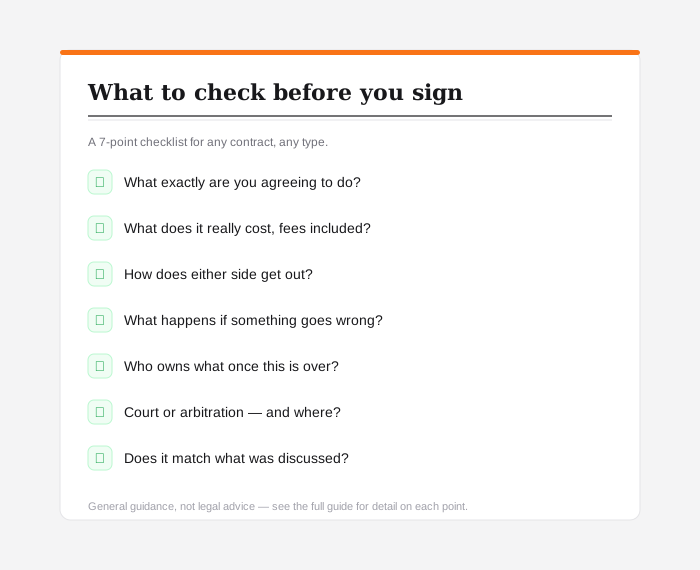
Whatever kind of contract you're about to sign, seven things are worth checking every time: what you're actually agreeing to do, what it costs (including the fees that aren't in the headline number), how either side gets out, what happens if something goes wrong, who owns what afterward, whether disputes go to court or arbitration, and whether the document in front of you matches what was actually discussed. This is the type-agnostic version — for the clauses specific to your contract type, see the guides linked at the end.
1. What exactly are you agreeing to do (or not do)?
Read the scope section as if you'll be held to the literal words, not the spirit of the conversation. Vague scope ("ongoing support as needed") is the single most common source of disputes — ask for it to be specific: what's included, what counts as extra, how changes get priced.
2. What does it actually cost — including the parts not in the headline number?
Check for fees that live outside the main price: late fees, renewal fees, cancellation penalties, "administrative" charges. A contract that looks like $X often has real cost elsewhere in the fine print.
3. How does either side get out of this?
Look for the termination clause specifically — not just whether you can leave, but on what notice, at what cost, and whether the other side has the same right or a better one. An agreement that's easy for them to exit and hard for you to exit is a real imbalance.
4. What happens if something goes wrong?
This is liability language: who pays if the work is late, defective, or causes a loss, and is there a cap on how much either side owes the other. One-sided liability (you're on the hook for everything, they're capped at a small fee) is worth pushing back on.
5. Who owns what once this is over?
For freelance and vendor work specifically: does ownership of the work transfer to the client on delivery, or only after final payment clears? For any contract with your data or IP in it: what happens to it if the relationship ends?
6. Court or arbitration — and where?
Check the dispute-resolution clause: does it send disagreements to arbitration instead of court, and if so, where (a distant location can make disputes impractical to pursue)? See Arbitration clause for what the term means and what to look for.
7. Does the document match what was actually discussed?
The most overlooked check: re-read against your own notes or email thread from the negotiation. Verbal promises ("don't worry, we'll be flexible on that") that didn't make it into the text usually don't count once you've signed. If it's not in the document, it's not part of the deal — ask for it to be added before you sign.
FAQ
Is this checklist different for every type of contract? The seven questions apply everywhere, but what counts as a red flag under each one is type-specific — a lease's biggest risk is usually the early-termination penalty, a freelance contract's is usually scope and payment terms. See How to Read a Lease or How to Read a Freelance Contract for the specifics.
How long should I take to review a contract before signing? There's no fixed rule, but rushing a review is how expensive terms get missed — if you're being pressured to sign "today or the deal's off," that pressure itself is worth noticing.
Can I ask for changes, or is the contract final once it's sent to me? Almost everything is negotiable before signature, even in contracts that look like standard templates. See What to Negotiate Before You Sign for specific language to use.
Not legal advice — a general checklist. For a contract with real money or risk on the line, this is a starting point, not a substitute for a lawyer.